
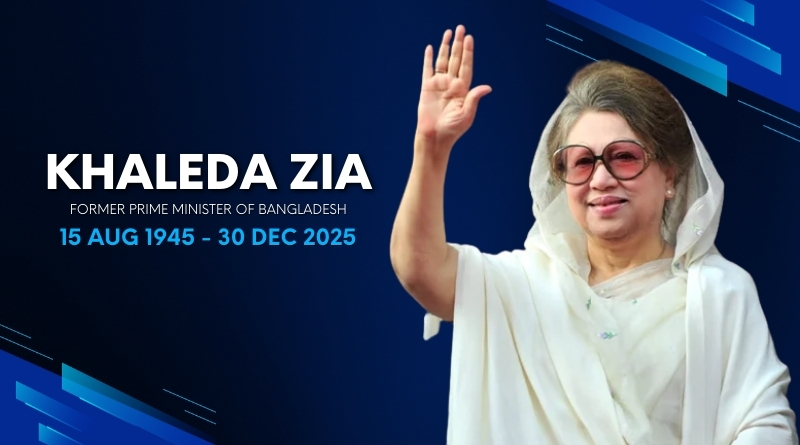
Khaleda Zia: Life, Leadership, and Legacy of Bangladesh’s Former Prime Minister
Khaleda Zia was one of the most influential and polarizing political figures in the history of Bangladesh. As the country’s first female Prime Minister and a central figure in post-independence politics, her life reflected resilience, controversy, and enduring impact. From leading democratic movements to shaping national governance, Khaleda Zia’s journey remains deeply woven into Bangladesh’s political identity.
Early Life and Background
Khaleda Khanam Zia was born in August 1945 in Jalpaiguri, then part of British India (now West Bengal, India). Raised in a Bengali Muslim family, she described herself as largely self-educated, attending local schools before marrying Ziaur Rahman, a Pakistan Army officer, in 1960. Following marriage, she adopted the name Khaleda Zia.
Her early life remained largely private until national events thrust her into the public eye. During the Bangladesh Liberation War of 1971, she endured detention by Pakistani forces, an experience that shaped her resilience during future political struggles.
Entry into Politics
Khaleda Zia’s political life began after the assassination of her husband, President Ziaur Rahman, in 1981. In 1982, she formally joined the Bangladesh Nationalist Party (BNP), founded by her late husband. By 1984, she rose to become the party’s chairperson, emerging as a key leader against military ruler Hussain Muhammad Ershad.
Her uncompromising stance against authoritarian rule and repeated house arrests turned her into a symbol of resistance. Khaleda Zia played a crucial role in the 1990 mass uprising that ultimately led to the fall of Ershad’s regime and the restoration of democracy.
Prime Ministerial Tenures
Khaleda Zia served as Prime Minister of Bangladesh three times:
- 1991–1996
- February–March 1996
- 2001–2006
First Term (1991–1996)
Her first term marked a historic moment as she became Bangladesh’s first female Prime Minister. Her government restored the parliamentary system through the 12th Constitutional Amendment. Major reforms focused on:
- Free and compulsory primary education
- Free education for girls up to grade 10
- Economic liberalization, including VAT introduction
- Strengthening local government institutions
This period saw significant improvements in education access and administrative reforms.
Second Term (1996)
Her second term was brief and controversial, following elections boycotted by opposition parties. Political pressure forced her to relinquish power, paving the way for a caretaker government system.
Third Term (2001–2006)
During her third term, Bangladesh experienced economic growth, increased foreign investment, and expanded industrial and service sectors. Her government pursued a “Look East” foreign policy and strengthened Bangladesh’s role in UN peacekeeping missions.
However, this period was also marred by allegations of corruption, governance failures, and Bangladesh ranking poorly on global corruption indices.
Legal Challenges and Imprisonment
Following political unrest in 2006 and a military-backed caretaker government in 2007, Khaleda Zia faced numerous corruption charges. In 2018, she was sentenced to prison in the Zia Orphanage Trust and Zia Charitable Trust cases.
Due to deteriorating health, she was transferred to hospital care in 2019 and later released under house arrest on humanitarian grounds. In 2024–2025, amid major political changes in Bangladesh, she was acquitted in multiple graft cases, restoring her legal standing.
Health Struggles and Death
Khaleda Zia suffered from prolonged illnesses, including liver cirrhosis, kidney complications, diabetes, and arthritis. Despite receiving treatment in Bangladesh and abroad, her health continued to decline.
On 30 December 2025, Khaleda Zia passed away at Evercare Hospital in Dhaka, ending a political era. Her death prompted three days of state mourning, with condolences pouring in from national and international leaders.
Political Legacy
Khaleda Zia’s legacy is complex and deeply influential:
- Pioneer for women in leadership in the Muslim world
- Central figure in Bangladesh’s two-party political system
- Instrumental in restoring democracy after military rule
- Remembered for education reforms and economic policies
- Criticized for corruption controversies and political polarization
Her long-standing rivalry with Sheikh Hasina defined Bangladeshi politics for over three decades, shaping governance, public discourse, and electoral dynamics.
Conclusion
Khaleda Zia’s life was one of struggle, power, sacrifice, and controversy. Whether hailed as a fighter for democracy or criticized for governance failures, her influence on Bangladesh’s political landscape is undeniable. As history reflects on her leadership, Khaleda Zia will remain remembered as a towering figure who left an indelible mark on the nation’s democratic journey.