
Can Dogs Detect Cancer? The Role of AI in Early Screening
Cancer detection often depends on medical tests, imaging, and laboratory analysis. But researchers are also studying an unusual tool that has been part of human life for centuries—the dog’s powerful sense of smell. Dogs have an extraordinary ability to detect subtle odors, and researchers are investigating whether this ability can help identify chemical changes associated with cancer.
A new approach combines trained dogs with artificial intelligence (AI) to develop a non-invasive method for cancer screening. A Bengaluru-based startup is working on technology that uses dogs’ sense of smell alongside AI to identify patterns that may be associated with several types of cancer. According to the source, testing involving more than 1,500 people across six hospitals in Karnataka recorded more than 90% accuracy in identifying seven major cancer types. However, larger studies are still needed before firm conclusions can be made about the technology.
How Can Dogs Detect Cancer?
Dogs have a highly developed sense of smell. The source explains that humans have around 500,000 smell receptors, while dogs can have more than 300 million. This difference gives dogs an exceptional ability to detect and distinguish odors.
When certain diseases develop in the body, they can cause metabolic and chemical changes. These changes may produce specific compounds that can be released through a person’s breath or other biological samples.
Researchers are interested in whether trained dogs can recognize these odor patterns.
The concept is not simply that a dog “smells cancer” in a general sense. Instead, the dog is trained to identify particular odor patterns associated with samples from people with cancer.
You Can Also Read : What Responsibilities Do Developers Have When Using Generative AI?
The Role of AI in Cancer Detection
While dogs have a powerful sense of smell, relying entirely on their behavior creates challenges. Dogs can become tired, their behavior can vary from day to day, and their responses may not always be easy for humans to interpret.
This is where artificial intelligence can play an important role.
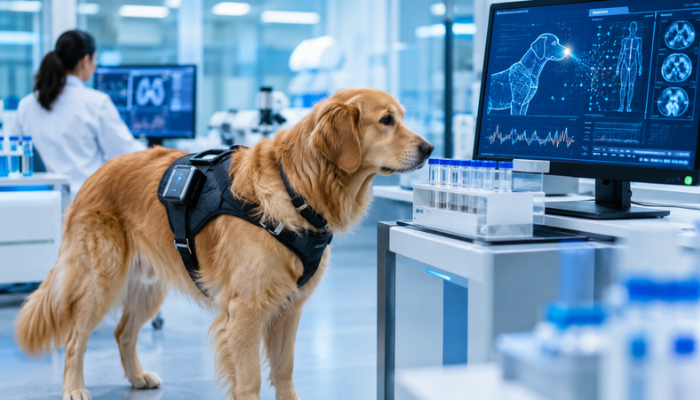
The technology described in the source uses sensors fitted to dogs to collect information about their activity, breathing patterns, and body language. The system then uses AI to analyze this information and estimate whether the dog is responding to a cancer-related odor.
This creates a combination of:
- Dogs with highly sensitive smell receptors
- Sensors that record physical responses
- AI systems that analyze collected data
- Biological samples that may contain disease-related chemical signals
The goal is to make the detection process more measurable and potentially easier to scale.
How Are Dogs Trained to Detect Cancer?
Training is an important part of the process. The source describes a positive-reinforcement approach in which dogs are presented with different samples.
When a dog identifies a sample containing the target odor, it receives a reward. Over time, the dog learns to associate a particular odor pattern with a positive response.
Dogs can show different behaviors when they identify a target sample. Some may stop, stand near a particular location, or scratch at a sample. These behavioral changes provide researchers with signals that the dog has detected something different.
Sensors and AI can then help interpret these responses rather than relying only on human observation.
You Can Also Read : What Is ChatGPT Prism? Features, Benefits & Use Cases Explained
Why Is Non-Invasive Screening Important?
One of the potential advantages of this approach is that it could use simple biological samples rather than invasive procedures.
The source describes a process in which patients breathe into a cotton mask for approximately 10 minutes. The collected sample can then be presented to trained dogs for analysis.
If this type of technology can eventually be validated through larger studies, it could potentially provide another method for screening people without requiring complex procedures at the initial stage.
However, this should not be confused with a proven replacement for established cancer diagnostic methods.
What Does the Reported Accuracy Mean?
The source reports that tests involving more than 1,500 people across six hospitals in Karnataka recorded more than 90% accuracy across seven major cancer types.
This finding is interesting, but an accuracy figure from one study does not by itself establish that a screening technology is ready for widespread clinical use.
Researchers need larger and carefully designed studies to determine how consistently the technology performs across different populations, healthcare settings, cancer stages, and sample types.
It is also important to distinguish screening from diagnosis. A screening tool may identify people who need further medical evaluation, while a diagnosis generally requires additional clinical testing.
Can This Technology Replace Traditional Cancer Tests?
At present, the source does not establish that trained dogs and AI can replace conventional cancer screening or diagnostic methods.
Instead, the technology is being investigated as a potential additional approach to early detection.
Medical professionals would still need to evaluate any positive screening result using appropriate clinical tests. A dog’s response or an AI-generated signal should not be treated as proof that an individual has cancer.
Further research will be necessary to establish the technology’s reliability and practical role in healthcare.
You Can Also Read : Top 10 High Paying Computer Courses After 12th
The Challenge of Scaling Dog-Based Detection
One of the biggest questions is scalability.
A small group of trained dogs cannot realistically process unlimited samples manually. Dogs can also become tired, and their behavior can change depending on the day or circumstances. The source specifically identifies these behavioral variations as a challenge for scaling the technology.
AI and sensor technology may help address part of this problem by recording and analyzing a dog’s responses systematically.
The long-term goal could be to combine the biological sensitivity of dogs with the consistency and data-processing capabilities of machines.
What Could the Future Hold?
The combination of dogs and AI represents an unusual intersection of biology, technology, and healthcare research.
Dogs provide an extremely sensitive biological detection system, while AI can process large amounts of behavioral and sensor data. Together, these technologies may offer researchers a new way to study disease-related chemical signals.
However, the approach is still being investigated. Larger studies are needed to determine whether the reported results can be reproduced consistently and whether the technology can work reliably at a larger scale.
Conclusion
So, can dogs detect cancer? Research suggests that trained dogs can respond to odor patterns associated with certain biological changes, and researchers are now combining this ability with artificial intelligence to make the process more measurable.
The reported results from testing in Karnataka are promising, with the source describing more than 90% accuracy across seven major cancer types. But these findings require further validation through larger studies before the technology can be considered an established cancer-screening method.
The combination of a dog’s extraordinary sense of smell, wearable sensors, and AI could become an interesting area of medical research. For now, it should be viewed as an emerging research approach rather than a replacement for established cancer screening and diagnostic procedures.