
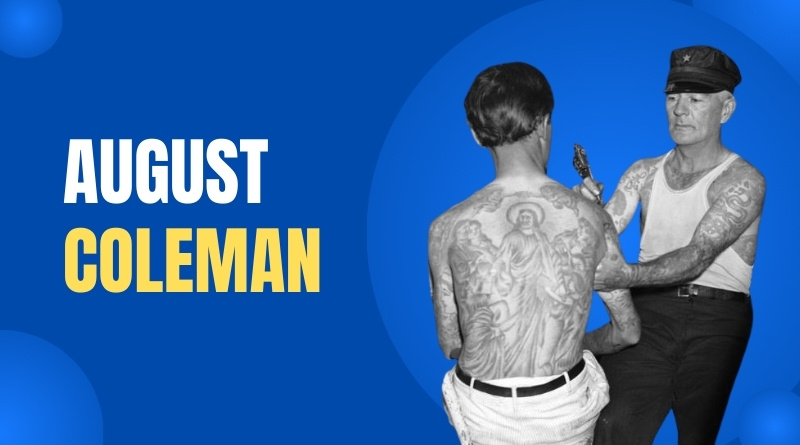
August Coleman Biography: Early Life, Career, and Success
August Bernard “Cap” Coleman was one of the most influential figures in the history of American tattooing. Widely known as “The Godfather of American Tattooing,” Coleman played a pivotal role in shaping modern tattoo culture through his artistry, innovation, and dedication to the craft. His tattoo flash designs continue to inspire generations of tattoo artists worldwide.
Early Life of August Coleman
August B. Coleman was born on 15 October 1884, near Cincinnati, Ohio, USA. Very little is documented about his childhood, adding an air of mystery to his early years. Coleman claimed that his father was a tattoo artist, and it is believed that his family lived a transient lifestyle, traveling with carnivals.
At one point, Coleman worked as a mariner, a profession that exposed him to tattoo culture among sailors—an influence that would later define his artistic direction. During this period, he was frequently tattooed by Jesse Frederick Barber, a key figure in his early exposure to professional tattooing.
Career Journey and Tattoo Legacy
Coleman’s professional career truly began in the carnival circuit, where he worked as both a tattoo artist and a tattooed attraction. Performing with shows such as Greater Smith Shows, he became known as “The Human Picture Gallery.” His body art and tattooing skills drew widespread attention and admiration.
In 1912, Coleman stepped away from carnival life to refine his skills in Barber’s tattoo studio, where he learned the fundamentals of professional tattooing. This marked a turning point in his career.
By 1918, Coleman had relocated to Norfolk, Virginia, where he opened a tattoo parlor on East Main Street. With the rise of World War I and the establishment of a naval port in Norfolk, his clientele grew rapidly, primarily consisting of sailors and servicemen. His tattoo shop became one of the most recognized studios of its time.
Coleman was especially known for his tattoo flash designs, which became standard references across American tattoo studios. His bold lines, iconic imagery, and classic motifs influenced legendary tattooists such as Sailor Jerry and Franklin Paul Rogers.
Challenges and Later Years
In 1950, tattooing was declared illegal in Norfolk due to a city ordinance. Like many tattoo artists of the era, Coleman was forced to relocate. He moved across the Elizabeth River to Portsmouth, Virginia, where he continued working alongside fellow tattoo artist Tex Peace.
Despite legal restrictions and changing times, Coleman remained committed to tattooing until his later years.
Death and Enduring Success
August “Cap” Coleman passed away on 20 October 1973, at the age of 89. Although his life ended decades ago, his influence remains deeply embedded in tattoo culture. Today, he is remembered not only for his artistic skill but also for establishing foundational standards in American tattooing.
His work laid the groundwork for what tattooing has become today—an accepted and respected art form.
August Coleman – Quick Stats (For Image/Info Box)
- Full Name: August Bernard Coleman
- Nickname: Cap
- Born: 15 October 1884
- Birthplace: Near Cincinnati, Ohio, USA
- Died: 20 October 1973
- Age: 89 years
- Profession: Tattoo Artist
- Known As: The Godfather of American Tattooing
- Famous For: Classic tattoo flash designs
- Active Locations: Ohio, Virginia (Norfolk & Portsmouth)
- Spouse: Lena Hewlett (d. 1956)
Final Thoughts
August Coleman’s life is a testament to resilience, creativity, and artistic vision. From carnivals to naval ports, and from outlawed tattooing to legendary status, his journey shaped the foundation of American tattoo art. His legacy lives on through timeless designs that continue to define traditional tattooing today.